

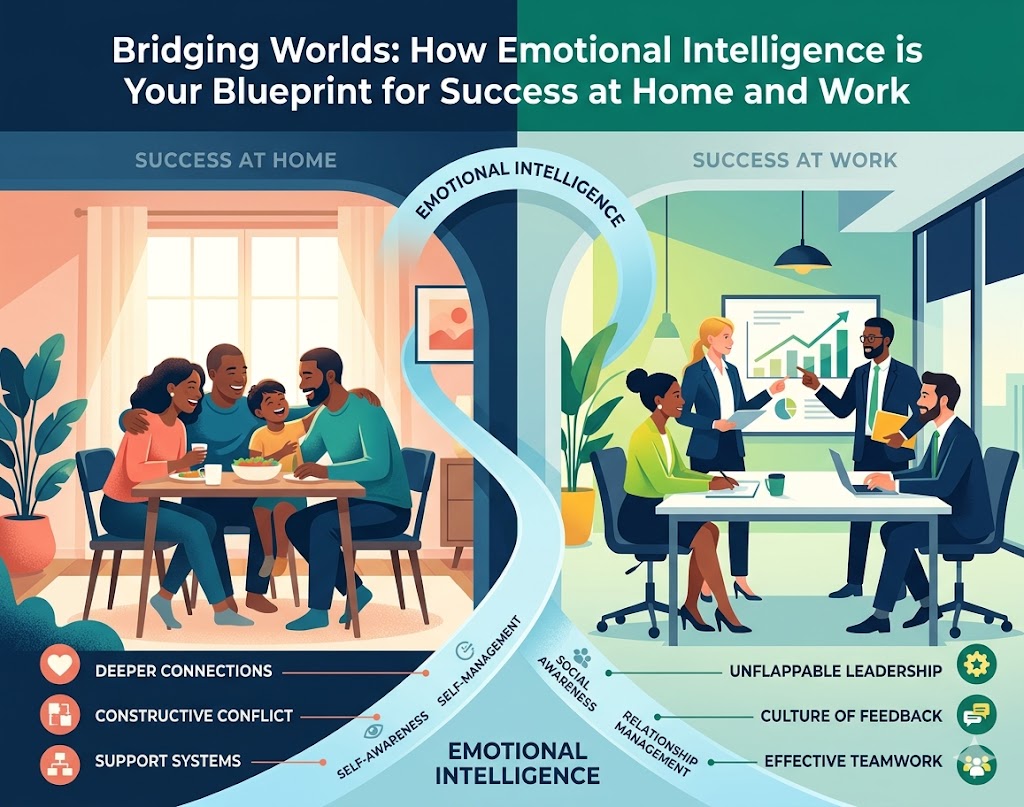
Bridging Worlds: How Emotional Intelligence is Your Blueprint for Success at Home and Work
Think of the most successful person you know. When you look deeper, past technical skills and raw IQ, what are they really like to be around? Chances are, they listen, stay calm under pressure, and navigate difficult conversations with grace. They possess high Emotional Intelligence (EQ), and it’s likely the secret engine driving their achievements.
It’s a common misconception that our professional self and our personal self are two entirely separate entities. The truth is, how we manage ourselves and our relationships follows us from the kitchen table to the boardroom. EQ isn’t just a “soft skill”—it’s the fundamental blueprint for thriving in all aspects of life. Here’s how.
What is Emotional Intelligence, Exactly?
It goes beyond simply “being nice.” At its core, EQ is the ability to recognize, understand, and manage your own emotions, as well as recognize, understand, and influence the emotions of others. As Dr. Travis Bradberry and Dr. Jean Greaves detail in Emotional Intelligence 2.0, EQ consists of four core skills that form two primary competencies:
- Personal Competence (What I manage):
- Self-Awareness: The ability to accurately perceive your own emotions in the moment and understand your tendencies across situations.
- Self-Management: What happens when you act—or don’t act—after becoming aware of your emotions. This is your ability to stay flexible and direct your behavior positively.
- Social Competence (What I build): 3. Social Awareness: Your ability to accurately pick up on emotions in other people and understand what’s really going on with them. This involves reading the room, which requires active listening. 4. Relationship Management: Your ability to use your awareness of your own emotions and those of others to manage interactions successfully. This builds trust, manages conflict, and strengthens teamwork.
Thriving at Home: EQ is the Heart of a Healthy Family
It can be easy to see how EQ applies to leadership, but it is equally vital in the quiet moments of our personal lives. Home is often where our relationships are deepest and where our actions have the most significant impact on those we love.
Here’s where a high EQ pays off:
- Deeper Connections: Self-awareness allows you to show up as your authentic self. When you are honest about your feelings, you invite others to be the same, building vulnerability and trust.
- Constructive Conflict: Families will argue. Self-management is what stops a minor disagreement about chores from escalating into a heated battle. When you can breathe through a moment of frustration, you choose an answer, not a reaction.
- Active Listening & Empathy: In moments of household chaos, are you really listening to your partner or child? Social awareness allows you to focus on them, listening without distraction, which validation and makes them feel truly heard.
- Stronger Support Systems: Effectively managing relationships isn’t just about problem-solving. It’s about showing up consistently and being a reliable source of support. This reduces burnout for everyone in the home and fosters a loving, cooperative atmosphere.
Succeeding at Work: EQ is Your Ultimate Performance Metric
While raw technical skill or IQ may get you the job, your EQ determines how far you’ll climb. The data supports this: EQ is responsible for 58% of performance in all types of jobs. In fact, 90% of top performers are also high in emotional intelligence.
Here’s what that looks like in action:
- The “Unflappable” Leader: In times of high pressure, team members look to their leader. A manager with high self-management can stay calm, process information without panic, and make decisive, rational choices. This breeds confidence in their leadership.
- Building a Culture of Feedback: Effective feedback is a two-way street. Social awareness helps you deliver critiques that are constructive and motivating, not crushing. Likewise, it helps you receive feedback without defensiveness, seeing it as an opportunity for growth.
- Empathetic Management: People want to work for and with people they respect. An empathetic leader who practices social awareness can understand what their team is feeling, whether it’s anxiety about a change or pride in a major win, and validate that experience.
- Effective Teamwork: No one succeeds alone. Mastering relationship management allows you to navigate diverse communication styles, mediate disputes, and build the trust required for true collaboration.
The Good News: EQ Can Be Learned
Unlike IQ, which is generally fixed, your EQ is highly trainable. You don’t have to be born with an innate ability to read a room; you can practice it. By building these skills—even one at a time—you are directly investing in your long-term success and your daily happiness, across every part of your life. Start small: breathe before you speak, practice listening without interrupting, and pay attention to what your body tells you in stressful moments. Your personal and professional worlds will thank you.
Read: Emotional Intelligence 2.0
by Travis Bradberry
Emotional intelligence has the following 4 key components:
Self-Awareness: The ability to know your emotions, as well as your strengths and weaknesses, and recognize their impact on performance and relationships.
Self-Management: The ability to control both positive and negative emotions and impulses and be flexible and adaptive as situations warrant.
Social Awareness: The ability to have empathy for others, navigate politically, and network proactively.
Relationship Management: The ability to inspire through persuasive communication, motivation, building bonds, and disarming conflict among individuals.
The managers who have had a strong impact on my job satisfaction had high emotional intelligence and leadership effectiveness. They brought out the best in me because they were strong communicators, they were empathetic, and they made me feel appreciated.
Why High Emotional Intelligence in Leadership Drives Employee Engagement
The ability to connect emotionally with employees is essential for leadership effectiveness. In part, that’s because the way a leader makes you feel can impact your engagement as well as your productivity. Emotions can weave through every work situation you experience, including:
- Change and uncertainty
- Interactions with colleagues
- Conflict and relationships
- Effort and burnout
- Achievement and failure
According to Closing the Engagement Gap, a book by researchers Julie Gebauer and Don Lowman, only one-fifth of the global workforce is considered fully engaged. That’s especially problematic when organizations go through challenging times like the recent pandemic because, in times like these, employers depend on their employees to help the organization come through strong and equipped for the future.
If employees are committed and engaged, they’re more productive, which positively impacts organizational profitability.
Editorial Reviews
“Emotional Intelligence 2.0 is a fast read with compelling anecdotes and good context in which to understand and improve your score.”
—NEWSWEEK
“Surveys of 500,000 people on the role of emotions in daily life have enabled the authors to hone EQ assessment to a 28-question online survey that can be completed in seven minutes.”
—The Washington Post
“Read worthy strategies for improving emotional intelligence skills make this our how-to book of the week. It’s nice to know that average IQ doesn’t limit a person to average performance. And who can resist an online quiz with instant feedback?”
—Newsday
From the Inside Flap
“Emotional Intelligence 2.0 succinctly explains how to deal with emotions creatively and employ our intelligence in a beneficial way.”
—The Dalai Lama
Read: Emotional Intelligence 2.0
by Travis Bradberry
Related Posts

Launch Your Own Brand Right Now (For Free)
Building a personal digital brand isn’t just a creative outlet—it’s one of the…


Work [better] from home with Google Workspace
It’s simple to set up, use, and manage, so your business can focus on what…